
The US Navy loses another war
17 hours ago

Missouri’s Res. 13, however, reflects exactly what this nation’s Religious Right wants – a country where its extreme agenda is advanced by government. That’s why so many Religious Right activists loathe the First Amendment and perpetually claim that it contains no clause separating government and religion. These folks want laws that ban reproductive rights, stifle advancement of civil rights for gays and allow public school teachers to lead their students in Christian prayer, Bible readings and other religious activities.
The resolution is also reflective of the Religious Right’s warped understanding of democracy and the U.S. Constitution. The Missouri resolution states that America’s Founding Fathers envisioned our nation’s governing document as setting up a Christian nation. TV preachers Pat Robertson, Jerry Falwell and a host of other Religious Right pundits have asserted similar claims for years.
The truth is that the nation’s Constitution was not based on sectarian principles. It is a secular document created by men who were witness to the destruction wrought by the union of religion and government in Europe and America’s early colonies. Nowhere does the word “God” appear in the Constitution. Founding Father and author of the First Amendment James Madison did not, regardless of the Missouri lawmakers’ puffery, envision an American theocracy.
In 1823, Madison wrote, “The settled opinion here is that religion is essentially distinct from Civil Govt. and exempt from its cognizance; that a connection between them is injurious to both….”
Reality, however, seems of no concern to some Missouri lawmakers or opportunistic Religious Right operatives who are bent on enforcing their religious strictures on the entire nation.
"Drat! These pesky scientific facts won't line up behind my beliefs!"Doonesbury on the White House's approach to science.
"Then challenge them Steve!"
So many of the principles to which our country has, by consensus, adhered for decades, through Republican and Democratic Administrations, are being attacked and destroyed by this Administration. This process is inexorably changing the kind of country we are and the system of government under which we live. That is the very definition of "radical," and that term applies to this Administration as much as it applies to anything.- Glenn Greenwald commenting on the Bush administration's efforts to prosecute journalists under espionage laws
In the paradox of Achilles and the Tortoise, we imagine the Greek hero Achilles in a footrace with the plodding reptile. Because he is so fast a runner, Achilles graciously allows the tortoise a head start of a hundred feet. If we suppose that each racer starts running at some constant speed (one very fast and one very slow), then after some finite time, Achilles will have run a hundred feet, bringing him to the tortoise's starting point; during this time, the tortoise has "run" a (much shorter) distance, say one foot. It will then take Achilles some further period of time to run that distance, during which the tortoise will advance farther; and then another period of time to reach this third point, while the tortoise moves ahead. Thus, whenever Achilles reaches somewhere the tortoise has been, he still has farther to go. Therefore, Zeno says, swift Achilles can never overtake the tortoise. Thus, while common sense and common experience would hold that one runner can catch another, according to the above argument, he cannot; this is the paradox.Zeno is obviously wrong, as anyone can see that Achilles will in fact overtake the tortoise at some point if he is running faster, but it resisted mathematical refutation until Cantor came up with his theory of tranfinites in the late 19th century. What people had a difficult time accepting was that an infinite number of distances could converge on a finite sum (1.1, 1.11, 1.111 .... 2).
President Bush's budget would increase the federal deficit by $35 billion this year and by more than $1.2 trillion over the next decade, the Congressional Budget Office reported on Friday.And here's the best part
The nonpartisan budget office said that Mr. Bush's tax-cutting proposals would cost about $1.7 trillion over the next 10 years and that his proposals to partly privatize Social Security would cost about $312 billion during that period.
The optimistic outlook also assumes that Congress freezes or cuts the vast majority of discretionary government programs outside of military and domestic security ones.See how that works? Run up a huge deficit so that you can sacrifice government programs which help people (worker protection, food safety, education, environmental protections, science research, "community development block grants, low-income housing, child-support enforcement against deadbeat fathers and scores of other programs with support in Congress.") at the altar of the military-industrial complex.
To state that no one could anticipate the breech of the levees is on its face an absurd claim. There is no excuse for the President not knowing that a Category 5 hurricane (what they would have been preparing for) aproaching New Orleans would not only possibly breech the levees, but would PROBABLY breech them.Update - Media Matters demonstrates the utter bankruptcy of the President's statement that no one could have anticipated the breech of the levees.
And in regards to the video, it doesn't really matter whether it said topped or breeched. The end result is flooding, which is what The President was trying to excuse FEMA's lack of preparedness for.
Preliminary investigations into the disaster at West Virginia's Sago Mine are turning up serious questions—among them whether the federal government will mount an aggressive drive for the truth about the January 2 disaster, in which 12 coal miners were killed.A heated political clash at a congressional hearing on mine safety Thursday suggests that the leadership necessary for an all-out effort is unlikely to come from the U.S. Congress or the Bush administration.
Hundreds of warnings on food labels could vanish under a measure moving toward approval in the House.
The bill would stop states from adding warnings that are different from federal rules. States currently add hundreds of extra warnings, indicating the presence of arsenic in water, mercury in fish, alcohol in candy, pesticides in vegetables and more."This legislation could overturn 200 state laws -- laws that the American people rely on every day to ensure the safety of the food they eat," Rep. Henry Waxman, D-Calif., said Thursday during House debate on the bill.
The food industry wants consistent warnings across state lines to reduce the cost of making many different labels. The industry has attracted broad support in the House, where a majority is co-sponsoring the bill.
[I]t is a sad but undeniable fact that for the past two decades the right wing of the Republican Party has worked closely with the fast food industry and the meatpacking industry to oppose food safety laws, worker safety laws, and increases in the minimum wage. One of President George W. Bush's first acts in office was to rescind a new OSHA ergonomics standard that would have protected millions of workers from cumulative trauma injuries. The National Restaurant Association and the American Meat Institute applauded the move. The newly appointed chairman of the House Subcommittee on Workforce Protections, which oversees all legislation pertaining to OSHA, is Representative Charles Norwood, a Republican from Georgia. During the 1990's Norwood sponsored legislation that would have prevented OSHA from inspecting unsafe workplaces or fining negligent employers. He has publicly suggested that some workers may actually be getting their repetitive stress injuries from skiing and playing too much tennis, not from their jobs.From Arrogant Capital (1994)
One of the Bush administration's first food safety decisions was to stop testing the National School Lunch Program's ground beef for Salmonella. The meatpacking industry's lobbyists were delighted; they had worked hard to end the testing, which the industry considered expensive, inconvenient, and unnecesary. But consumer groups were outraged. In the ten months that the USDA had been testing ground beef intended for schoolchildren, roughly 5 million pounds were rejected because of Salmonella contamination. Three days after it was announced Secretary of Agriculture Ann M. Veneman said that she'd never authorized the new policy, reversed course, and promised that the school lunch program's Salmonella testing would continue.*
Almost before it started, Clinton's administration got in trouble for being too close to lobbyists, insiders, and power brokers. But attention has focused not only on these relations, but on the President's willingness to make deals with business and financial lobbies even more quickly than with labor, environmental, and minority groups. Changes like these tell the real story of the transition from "Old Democrat" to "New Democrat." What Clinton has done is to shift his party from so-called interest-group liberalism to "interest-group centrism" - away from the pro-spending liberal-type lobbies that represented people (labor, seniors, minorities, and urban) to a more upscale centrist (or center-right) group that represents money (multinational business, banks, investment firms, trial lawyers, trade interests, super-lobbyists, investors, the bond market, and so on). In short, the new power structure of special interest-group centrism. This is the ultimate triumph of Washington's interest-group ascendency: the party of the people can no longer be the party of the people.And
Theoretically, a member of Congress represents a chunk of Missouri or Connecticut, and these voters alone get his or her mailings, satellite television feeds, and weekend visits: he or she is their representative. But the reality of what the average senator or congressman represents is a tailored slice of interest-group Washington: the party caucus or national committee, some contributors and polictical action committees, and a collection of think tanks and coalitions, associations, corporations, and unions. Grassroots party loyalty being so loose, 75 percent to 85 percent of senators and congressmen can use the right combination of interest-group backing to entrench themselves. to ordinary voters, representative government has become a shell - and behind it, only the influentials are truly represented.Meanwhile, there is a bipartisan resistance in Congress against taking the steps necessary to ensure that our elected officals can not be bought and sold.
Bush administration lawyers, fighting a claim of torture by a Guantanamo Bay detainee, yesterday argued that the new law that bans cruel, inhuman or degrading treatment of detainees in U.S. custody does not apply to people held at the military prison.
At a time when policymakers have made reducing unintended pregnancies a national priority, 33 states have made it more difficult or more expensive for poor women and teenagers to obtain contraceptives and related medical services, according to an analysis released yesterday by the nonpartisan Guttmacher Institute.
From 1994 to 2001, many states cut funds for family planning, enacted laws restricting access to birth control and placed tight controls on sex education, said the institute, a privately funded research group that focuses on sexual health and family issues.
The statewide trends help explain why more than half of the 6 million pregnancies in the United States each year are unintended and offer clues for tackling problems associated with teenage pregnancy and abortion, said researchers who specialize in the field.
The first report, delivered to Bush in early October 2002, was a one-page summary of a National Intelligence Estimate that discussed whether Saddam's procurement of high-strength aluminum tubes was for the purpose of developing a nuclear weapon.Lie 2
Among other things, the report stated that the Energy Department and the State Department's Bureau of Intelligence and Research believed that the tubes were "intended for conventional weapons," a view disagreeing with that of other intelligence agencies, including the CIA, which believed that the tubes were intended for a nuclear bomb.
The disclosure that Bush was informed of the DOE and State dissents is the first evidence that the president himself knew of the sharp debate within the government over the aluminum tubes during the time that he, Cheney, and other members of the Cabinet were citing the tubes as clear evidence of an Iraqi nuclear program. Neither the president nor the vice president told the public about the disagreement among the agencies.
The second classified report, delivered to Bush in early January 2003, was also a summary of a National Intelligence Estimate, this one focusing on whether Saddam would launch an unprovoked attack on the United States, either directly, or indirectly by working with terrorists.
The report stated that U.S. intelligence agencies unanimously agreed that it was unlikely that Saddam would try to attack the United States -- except if "ongoing military operations risked the imminent demise of his regime" or if he intended to "extract revenge" for such an assault, according to records and sources.
The single dissent in the report again came from State's Bureau of Intelligence and Research, known as INR, which believed that the Iraqi leader was "unlikely to conduct clandestine attacks against the U.S. homeland even if [his] regime's demise is imminent" as the result of a U.S. invasion.
On at least four earlier occasions, beginning in the spring of 2002, according to the same records and sources, the president was informed during his morning intelligence briefing that U.S. intelligence agencies believed it was unlikely that Saddam was an imminent threat to the United States.
However, in the months leading up to the war, Bush, Cheney, and Cabinet members repeatedly asserted that Saddam was likely to use chemical or biological weapons against the United States or to provide such weapons to Al Qaeda or another terrorist group.
In its drive to foster a more cooperative relationship with mining companies, the Bush administration has decreased major fines for safety violations since 2001, and in nearly half the cases, it has not collected the fines, according to a data analysis by The New York Times.
Federal records also show that in the last two years the federal mine safety agency has failed to hand over any delinquent cases to the Treasury Department for further collection efforts, as is supposed to occur after 180 days.With the deaths of 24 miners in accidents in 2006, the enforcement record of the Mine Safety and Health Administration has come under sharp scrutiny, and the agency is likely to face tough questions about its performance at a Senate oversight hearing on Thursday.
"The Bush administration ushered in this desire to develop cooperative ties between regulators and the mining industry," said Tony Oppegard, a top official at the agency in the Clinton administration. "Safety has certainly suffered as a result."
Bush declared four days after the storm, "I don't think anybody anticipated the breach of the levees" that gushed deadly flood waters into New Orleans. But the transcripts and video show there was plenty of talk about that possibility — and Bush was worried too.And
In dramatic and sometimes agonizing terms, federal disaster officials warned President Bush and his homeland security chief before Hurricane Katrina struck that the storm could breach levees, put lives at risk in New Orleans' Superdome and overwhelm rescuers, according to confidential video footage.Well, I for one sure feel safe with this man at the helm. Yes sir. If another terrorist attack is attempted, I've got full confidence in President Bush to handle it.
Bush didn't ask a single question during the final briefing before Katrina struck on Aug. 29, but he assured soon-to-be-battered state officials: "We are fully prepared."
Libby's lawyers hinted in court filings last week that memory loss will be "central themes" of Libby's defense. Libby's lawyers write: "...any misstatements he made during his FBI interviews or grand jury testimony were not intentional, but rather the result of confusion, mistake or faulty memory."
Libby's lawyers say that, during Libby's hectic days handling sensitive national-security matters, "it is understandable that he may have forgotten or misremembered relatively less significant events. Such relatively less important events include alleged snippets of conversations about Valerie Plame Wilson's employment status."
While technically all 435 seats in the U.S. House of Representatives are up for grabs in November, handicappers expect a mere 33 to be competitive, in part because many incumbents already have picked the voters they hope will return them to office.
Across the country, lawmakers will run for re-election in bizarrely shaped congressional districts carefully drawn to include voters who support them and exclude those who don't.
If fire ravages a national forest, as happened here in southwest Oregon when the Biscuit fire torched a half-million acres four years ago, the Bush administration believes loggers should move in quickly, cut marketable trees that remain and replant a healthy forest.See, it would be one thing to look at the available evidence, admit that post-fire logging is not in the best interests of the forrest, but then decide that economic needs outweighed the benefit of allowing the forest to recover naturally. One may or may not agree with that choice, but that approach allows for an honest debate. Yet, that is now how the Bush administration operates. No. Instead we are told that an action that will benefit the timber industries that have contributed campaign money to Bush and Rep. Walden is being done in the interest of protecting the forests. That is dishonest and insulting, as the purpose of this approach is to side step discussion by tricking the public into agreeing to these acts.
"We must quickly restore the areas that have been damaged by fire," President Bush said in Oregon four years ago after touring damage from the Biscuit fire. He called it "common sense."
Common sense, though, may not always be sound science. An Oregon State University study has raised an extraordinary ruckus in the Pacific Northwest this winter by saying that logging burned forests does not make much sense.
Logging after the Biscuit fire, the study found, has harmed forest recovery and increased fire risk. What the short study did not say -- but what many critics of the Bush administration are reading into it -- is that the White House has ignored science to please the timber industry. The study is consistent with research findings from around the world that have documented how salvage logging can strip burned forests of the biological diversity that fire and natural recovery help protect.
The study also questions the scientific rationale behind a bill pending in Congress that would ease procedures for post-fire logging in federal forests. This, in turn, has annoyed the bill's lead sponsor, Rep. Greg Walden (R-Ore.), who has received far more campaign money from the forest products industry than from any other source, according to data compiled by the Center for Responsive Politics.
The U.S. Environmental Protection Agency won't oppose the U.S. Department of Defense and DuPont Co.'s plan to dump a wastewater byproduct of a deadly nerve agent into the Delaware River.
The agency said it's assured of a safe treatment for up to 4 million gallons of caustic wastewater created in the treatment for VX, a chemical weapon with a pinhead-size potency to kill a human. DuPont is treating VX for disposal at its Newport Chemical Depot in Indiana.
The agent, once neutralized, would be shipped to DuPont's Chambers Works plant in Deepwater, N.J., for discharge into the river.
I would be concerned for several reasons:
While an international debate rages over the future of the American detention center at Guantánamo Bay, Cuba, the military has quietly expanded another, less-visible prison in Afghanistan, where it now holds some 500 terror suspects in more primitive conditions, indefinitely and without chargesPentagon officials have often described the detention site at Bagram, a cavernous former machine shop on an American air base 40 miles north of Kabul, as a screening center. They said most of the detainees were Afghans who might eventually be released under an amnesty program or transferred to an Afghan prison that is to be built with American aid.
But some of the detainees have already been held at Bagram for as long as two or three years. And unlike those at Guantánamo, they have no access to lawyers, no right to hear the allegations against them and only rudimentary reviews of their status as "enemy combatants," military officials said.
Privately, some administration officials acknowledge that the situation at Bagram has increasingly come to resemble the legal void that led to a landmark Supreme Court ruling in June 2004 affirming the right of prisoners at Guantánamo to challenge their detention in United States courts.
While Guantánamo offers carefully scripted tours for members of Congress and journalists, Bagram has operated in rigorous secrecy since it opened in 2002. It bars outside visitors except for the International Red Cross and refuses to make public the names of those held there. The prison may not be photographed, even from a distance.
I expect it will take the people making a lot of noise. The press has failed us in this matter, so firstly pressure needs to be put on media outlets to cover this issue. This can probably be accomplished at the local level more efficiently than at the national. After that, I'm not sure. But becoming aware of the problem is the first step.Such a plan has been formulated, it appears. The plan is to get natives of Kansas to write letters to their local papers pressuring the Chairman of the Senate Intelligence Committee, Senator Patrick Roberts (R- Kan), to call for an investigation of the NSA surveillance program. I have my doubts about whether or not Roberts can be swayed to deviate from his history of partisan protection of the Bush administration, but I welcome the effort.

Austria's treatment of Irving as a political dissident should offend both the people who defend the rights of political cartoonists to express their opinion of Islamic terrorists and the civil libertarians who leaped to the defense of University of Colorado professor Ward Churchill when he exercised his right to call the victims of 9/11 "little Eichmanns." Why doesn't it? Why aren't freedom lovers everywhere offended by Irving's court conviction?
Freedom is a principle that must be applied indiscriminately. We have to defend Irving in order to defend ourselves. Once the laws are in place to jail dissidents of Holocaust history, what's to stop such laws from being applied to dissenters of religious or political histories, or to skepticism of any sort that deviates from the accepted canon?
Attorney General Alberto Gonzales says Congress approved the National Security Agency's warrantless domestic wiretaps when it authorized a military response to the September 11 terrorist attacks. He also has said President Bush later decided not to ask for congressional approval of the surveillance program (approval he supposedly already had) because Congress probably would have said no (even though, by Gonzales' account, it already had said yes).Conclusion
Now the Bush administration is pursuing legislation suggested by Sen. Mike DeWine (R-Ohio) that would provide the congressional blessing it says it always had yet never sought. But since the president apparently thinks he has unilateral authority to do whatever he deems necessary to prevent terrorism, any law that aims to regulate his conduct in this area may not accomplish much.
The administration's defense of the NSA's wiretaps suggests the PATRIOT Act's electronic surveillance provisions are superfluous at best. And if Bush thinks he has the authority to quietly disregard statutory restrictions on wiretaps, how can we be sure his administration is punctiliously following the legal requirements for seizing records or conducting physical searches? The president's secret exercise of undefined powers renders "clear red lines" invisible.Reminder
"He has refused his Assent to Laws, the most wholesome and necessary for the public good."This is one of the grieavances against King George III listed in the Declaration of Independence.
is a mode of argumentation that seeks to establish a contention by deriving an absurdity from its denial, thus arguing that a thesis must be accepted because its rejection would be untenable. It is a style of reasoning that has been employed throughout the history of mathematics and philosophy from classical antiquity onwards.
Its killing me, absolutely killing me, to see the democratic institutions of this country slipping away like grains of sand falling through an hour glass. A functioning democracy is predicated on the notion that the public has the information neccesary to allow them to fulfill their civic duties, yet the public is now being denied access to information at an unprecedented rate.
The restoration of classified status to more than 55,000 previously declassified pages began in 1999, when the Central Intelligence Agency and five other agencies objected to what they saw as a hasty release of sensitive information after a 1995 declassification order signed by President Bill Clinton. It accelerated after the Bush administration took office and especially after the 2001 terrorist attacks, according to archives records.
Article 19No nation that is party to that declaration has any business criminalizing thought.
Everyone has the right to freedom of opinion and expression; this right includes freedom to hold opinions without interference and to seek, receive and impart information and ideas through any media and regardless of frontiers.
Universal Declaration of Human Rights
The problem is partly a matter of style. Mr Barnes gushes over his “insurgent leader”—and then supports his gushing tributes with even more gushing tributes from Mr Bush's staff, as if they meant something. But a problem of style rapidly becomes a problem of substance. The political sage of the Weekly Standard does not go so far, say, as North Korean Communist hacks when they praise Kim Jong Il as a hero for the ages. Mr Barnes is at least open to doubt. But he leans in that direction. - The EconomistThe fact that The Economist saw fit to state that a book on our President written by a leading figure of the conservative movement leans in the direction of hero-worship that is demonstrated for North Korean dictator Kim Jong-il is symptomatic of a growing problem in America, which is thus: there is a significant portion of the population who in the aftermath of 9/11 are now willing to give deference to a central authority figure. This is troubling, as the foundation of our country was based on the rejection of that very principle.
Last week’s annual Conservative Political Action Conference signaled the transformation of American conservatism into brownshirtism. A former Justice Department official named Viet Dinh got a standing ovation when he told the CPAC audience that the rule of law mustn’t get in the way of President Bush protecting Americans from Osama bin Laden.Glenn Greenwald in his work at Unclaimed Territory has observed that there is a cultish nature to much of the defense that is being given for the Bush administration's grabs at extraConstitutional power, where self-styled conservatives are willing to cannibalize (metaphorically speaking) any conservative who is not willing to jettison his conservative principles in deference to George Bush (see here and here.) I believe Dave Neiwert correctly pointed out that the cult of Bush was a product of the movement, not vice versa. Afterall, Bush was chosen to be a Presidential candidate because his name could get him elected and because his family connections could raise large sums of campaign funds, not because he was any kind of a figure within the conservative movement - in essence, he was a viewed as a vessel that could be used to deliver a Presidential victory for the movement.
Former Republican congressman Bob Barr, who led the House impeachment of President Bill Clinton, reminded the CPAC audience that our first loyalty is to the US Constitution, not to a leader. The question, Barr said, is not one of disloyalty to Bush, but whether America "will remain a nation subject to, and governed by, the rule of law or the whim of men."
The CPAC audience answered that they preferred to be governed by Bush. According to Dana Milbanks, a member of the CPAC audience named Richard Sorcinelli loudly booed Barr, declaring: "I can’t believe I’m in a conservative hall listening to him say Bush is off course trying to defend the United States." A woman in the audience told Barr that the Constitution placed Bush above the law and above non-elected federal judges.
Using this model to frame the discussion, I think what we can readily see is that -- as with pseudo-fascism -- the conservative movement is still in a somewhat nascent stage as a political religion. The examples of more mature religions provide us with a fairly clear picture of where it's headed, however.And here's an example of where such a religion might one day take us.
And it won't necessarily be under the leadership of George W. Bush. The discrete conservative movement is structured such that it needs a "charismatic" figure at its head; it's essentially a psychological imperative for this kind of belief system.
So if the leader it elevates happens not, in fact, to actually be charismatic, as Bush really is not, then the movement will tailor its reality to make him so. True Believers -- having been steadily propagandized with Fox News and RNC talking points about Bush's superior character -- now really do see Bush as a charismatic figure, which leaves most non-believers shaking their heads.
But he is in essence disposable, an empty suit filled by the psychological needs of the movement he leads. He's sort of like a Fraternity President on steroids: Bush's presidency is all about popularity, not policy. He's a figurehead, a blank slate upon which the movement's followers can project their own notions of what a good president is about. And when his term is up, the movement will create a new "charismatic" leader.
It is not too much to require that what the wisest of mankind, those who are best entitled to trust their own judgment, find necessary to warrant their relying on it, should be submitted to by that miscellaneous collection of a few wise and many foolish individuals, called the public. The most intolerant of churches, the Roman Catholic Church, even at the canonization of a saint, admits, and listens patiently to, a "devil's advocate." The holiest of men, it appears, cannot be admitted to posthumous honours, until all that the devil could say against him is known and weighed. If even the Newtonian philosophy were not permitted to be questioned, mankind could not feel as complete assurance of its truth as they now do. The beliefs which we have most warrant for, have no safeguard to rest on, but a standing invitation to the whole world to prove them unfounded. If the challenge is not accepted, or is accepted and the attempt fails, we are far enough from certainty still; but we have done the best that the existing state of human reason admits of; we have neglected nothing that could give the truth a chance of reaching us: if the lists are kept open, we may hope that if there be a better truth, it will be found when the human mind is capable of receiving it; and in the meantime we may rely on having attained such approach to truth, as is possible in our own day. This is the amount of certainty attainable by a fallible being, and this the sole way of attaining it.- John Stuart Mill, On Liberty
Strange it is, that men should admit the validity of the arguments for free discussion, but object to their being "pushed to an extreme;" not seeing that unless the reasons are good for an extreme case, they are not good for any case. Strange that they should imagine that they are not assuming infallibility, when they acknowledge that there should be free discussion on all subjects which can possibly be doubtful, but think that some particular principle or doctrine should be forbidden to be questioned because it is so certain, that is, because they are certain that it is certain. To call any proposition certain, while there is any one who would deny its certainty if permitted, but who is not permitted, is to assume that we ourselves, and those who agree with us, are the judges of certainty, and judges without hearing the other side.
The Navy's former general counsel warned Pentagon officials two years before the Abu Ghraib prison scandal that circumventing international agreements on torture and detainees' treatment would invite abuse, according to a published report.
Legal theories granting the president the right to authorize abuse in spite of the Geneva conventions were unlawful, dangerous and erroneous, Alberto J. Mora advised officials in a secret memo. The 22-page document was obtained by The New Yorker for a story in its Feb. 27 issue.
What God that approves of death and violence committed because of a cartoon is worthy of the name "God"? Were these actions to be defended upon anything other than faith based fanatacism, there would be absolutely no rational justification for them. Can an infinite God be harmed by a cartoon? No. Then what is the problem? The problem is this: the orthodox are afraid someone might change their mind. That is it; freethought, to them is intolerable, as evidenced by the most despicable law of Islam, the one that makes apostasy punishable by death. Its a terrible, horrible, inhumane law. In fact, it is possibly the most cruel and malicious law ever created. It is a law designed to destroy a person's most valued possesion: their mind. It is a law designed to lock people into an internal mental prison where they are shackled by the bounds of orthodox beliefs. If a person can not live according to the dicates of their conscience, if they can not be free to think what thoughts they are compelled to think, then a person becomes a slave to their own beliefs and loses any true sense of autonomy. Is there anything more wicked than giving us freewill only that we would suffer eternal torture for using it? What a strange "gift." As Joseph Conrad once said, "all a man can betray is his conscience."
Nigerian Muslims protesting caricatures of the Prophet Muhammad attacked Christians and burned churches on Saturday, killing at least 15 people in the deadliest confrontation yet in the whirlwind of Muslim anger over the drawings.
It was the first major protest to erupt over the issue in Africa's most populous nation. An Associated Press reporter saw mobs of Muslim protesters swarm through the city center with machetes, sticks and iron rods. One group threw a tire around a man, poured gas on him and set him ablaze.
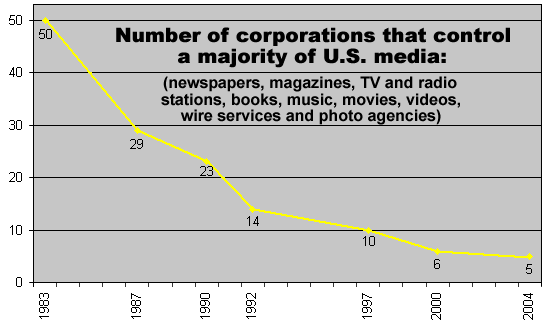
U.S. communications regulators should quickly relax ownership restrictions on the radio and broadcast television industry, Rep. Fred Upton, chairman of the House Energy and Commerce subcommittee on communications, said on Thursday.Make no mistake, if these regulations are eased, the monopolization of the press will only accelerate. And when the means of disseminating information becomes consolidated in the hands of the few, democracy dies.
Upton, a Michigan Republican, cited the proliferation of broadcast stations, cable, satellite television and radio and the Internet as evidence that consumers have sufficient choices to justify allowing companies to own more outlets.
"Common sense tells us that this explosion of media sources should eliminate any concern over a lack of diversity of views in the marketplace and competition," Upton said in a speech to the Media Institute.
"This growth (in sources) remains unabated and more than makes the case for regulatory relief in the broadcast sector," he said. Upton sent letters to U.S. Federal Communications Chairman Kevin Martin last week urging quick action.


